

When’s the Right Time to Seek Funding? (And the 3 Questions to Ask First)
How to know if your startup is truly investor-ready and avoid costly mistakes.
July 26, 2025
Set up a founder-friendly investor funnel, CRM stages, lead segmentation, follow-ups, and conversion tracking, plus spreadsheet + Notion templates.

Fundraising gets messy when your “pipeline” is a bunch of browser tabs + vibes.
The goal is one system where you can answer: who’s worth contacting next, what’s blocking progress, and what your conversion rate looks like from intro → meeting → partner track.
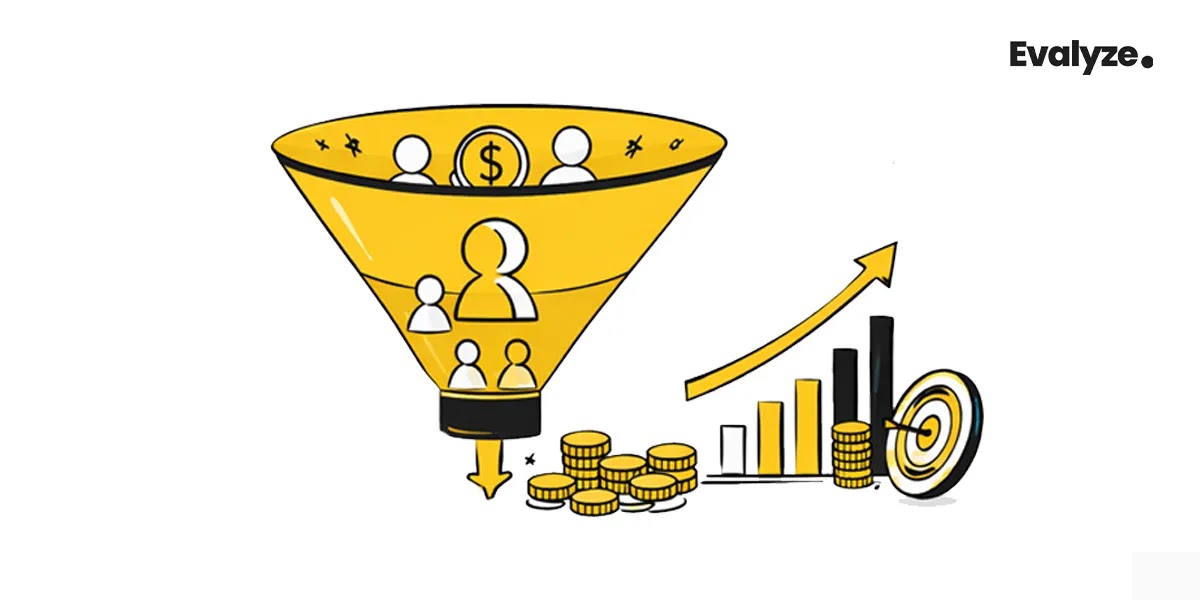
An investor funnel (also called an investment funnel) is a sequence of states an investor moves through, with clear exit criteria for each state, and it’s totally measurable.
A useful funnel has two layers:
Example: if “Meeting booked” includes coffee chats and partner calls, your metrics will lie. You’ll think your funnel is healthy, while your “real meetings” are quietly stuck at zero.
Pick one place. Commit.
Use stages that force clean decisions. Here’s a set:
Non-negotiable: “Engaged” requires a response. Opens, likes, “seen,” and “my friend knows them” are not engagement. If you allow that drift, your funnel conversion rate becomes fantasy math.
Reason codes are the difference between “we talked to 80 investors” and “we learned something useful.”
Use a short list you’ll actually apply:
Later, this becomes a real funnel report example: not only where you drop off, but why.
Don’t miss: Best Startup Hubs & Ecosystems for Fundraising
Segmentation isn’t bureaucracy. It’s how you protect your time.
This keeps your outreach from turning into a celebrity scavenger hunt.
Give yourself a scoring rubric you can explain to a co-founder in 10 seconds.
Example 0-10 scoring:
Rule: below 6/10 goes to Edge Fit or Do Not Contact (Now). Not because they’re “bad” investors, but your round needs focus.
You might also like: 20 AI Fundraising Tools for Startups

A follow-up should not be “just bumping this.” It should be “here’s what changed.”
Suggested cadence:
This cadence does something important: it creates a natural “yes / no / later” fork, instead of infinite limbo.
This is the real engine of your CRM. Every active investor row must have:
If it’s blank, it’s dead weight. Blank rows are how founders end up “fundraising” while nothing is actually happening.
Your future self will thank you for writing one line after every interaction:
That single line prevents you from rereading a 17-email thread just to remember what you promised.
Worth bookmarking: 7 Investor Follow-Up Emails

Pick a small set and keep it consistent:
These conversion points map to decisions you can actually influence: list quality, message clarity, deck clarity, and follow-up discipline.
Use formulas that are boring and truthful:
Time metrics matter because funnels can “look fine” while silently stalling. A pipeline with 20 “active” investors is meaningless if 15 haven’t been touched in 18 days.
Once a week, write a six-line update:
This is also raw material for a quarterly investor report later: it captures momentum, decisions, and learnings without reconstructing history from memory.
Founder's favourite: AI-Powered Investor Outreach: What Works and What Doesn't
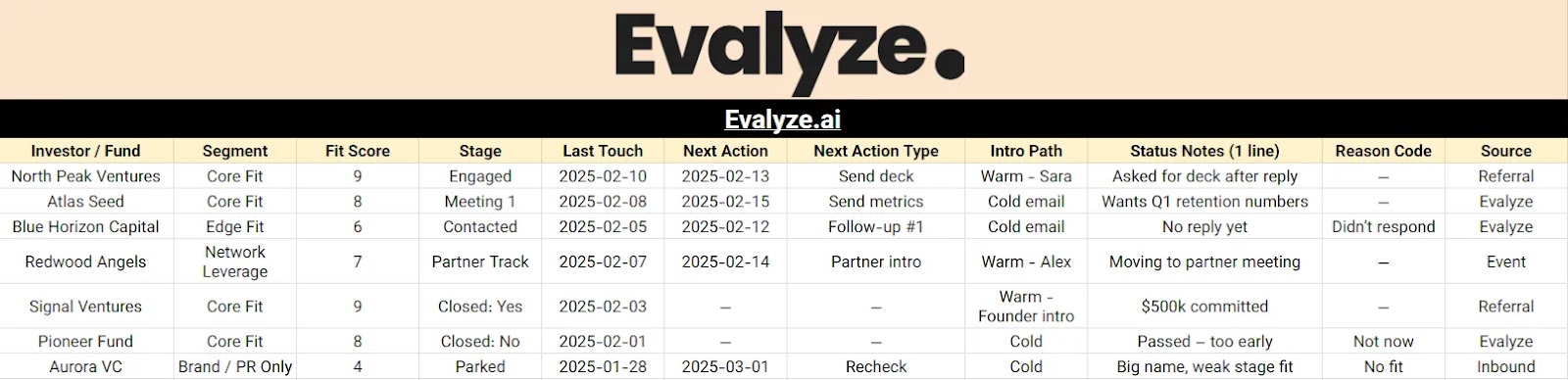
Tab 1: Investors (master)
Tab 2: Metrics
Tab 3: Outreach log (optional)
Tip: In Tab 2, you can create an investment funnel chart by counting each stage and graphing the results. The chart is not the goal; the definitions are.
Notion works well because you can create multiple views over the same database (actions today, stalled, core fit only).
Properties:
Views:
.jpg)
List-building is where founders waste weeks. Evalyze.ai investor matching helps you start with a fit-first investor pipeline by filtering investors by stage, sector, and check size, then exporting that list into your CRM with clean fields (investor, notes, segment starter).
Practical tip: Treat Evalyze output as Prospect until you run your quick fit score pass. That keeps your CRM honest.
.jpg)
If your deck is unclear, scaling outreach just spreads confusion faster.
Evalyze.ai pitch deck analysis helps you spot what’s not landing (positioning gaps, narrative jumps, metrics that raise questions) before you push Contacted volume. The goal isn’t perfection, it’s removing the “wait, what do they actually do?” moments that kill Engaged → Meeting 1.
Workflow:
Your CRM will tell you what to fix if you let it.
This is how your funnel gets better without sending more messages.
1. Engaged includes opens → engaged = reply/action only
Email opens are noisy (privacy features, preview panes, accidental opens). If you treat opens as “engagement,” your reply rate looks great while your meeting rate stays flat.
Count Engaged only when the investor does something observable: replies, asks for the deck, accepts an intro, or proposes a time.
2. No next action dates → every active row has a next step
A pipeline without next actions is just a list. “Active” should mean there’s a scheduled move: follow-up, send materials, intro request, or update.
If an investor has no next action date, they’re not in the funnel; they’re in storage.
3. Chasing Edge Fit because famous → protect Core Fit time
Big-name funds can be strategically useful, but they can also hijack your calendar while your highest-probability investors wait.
If you don’t ring-fence time for Core Fit, your funnel gets top-heavy: lots of “Contacted,” very little “Partner Track.”
4. Tracking counts only → track time-in-stage too
Counts tell you volume. Time tells you the truth. A funnel can look “healthy” (many investors at each stage) while it’s actually stalled (no one moves for 2-3 weeks).
Track median days per stage and create a “stuck” view (e.g., last touch > 7 days for active stages) so delays show up immediately.
Before you go: What Is Venture Capital?
FAQ
How to know if your startup is truly investor-ready and avoid costly mistakes.
July 26, 2025

Five targeted ChatGPT prompts to streamline your startup’s fundraising by crafting compelling pitch decks, emails, and investor messaging.
July 23, 2025