

5 ChatGPT Prompts That Help Founders Raise Funding Faster
Five targeted ChatGPT prompts to streamline your startup’s fundraising by crafting compelling pitch decks, emails, and investor messaging.
July 23, 2025
Copy 20 AI pitch deck prompts for your problem, market, traction, competition, financials, and ask, plus one master prompt for your full deck.
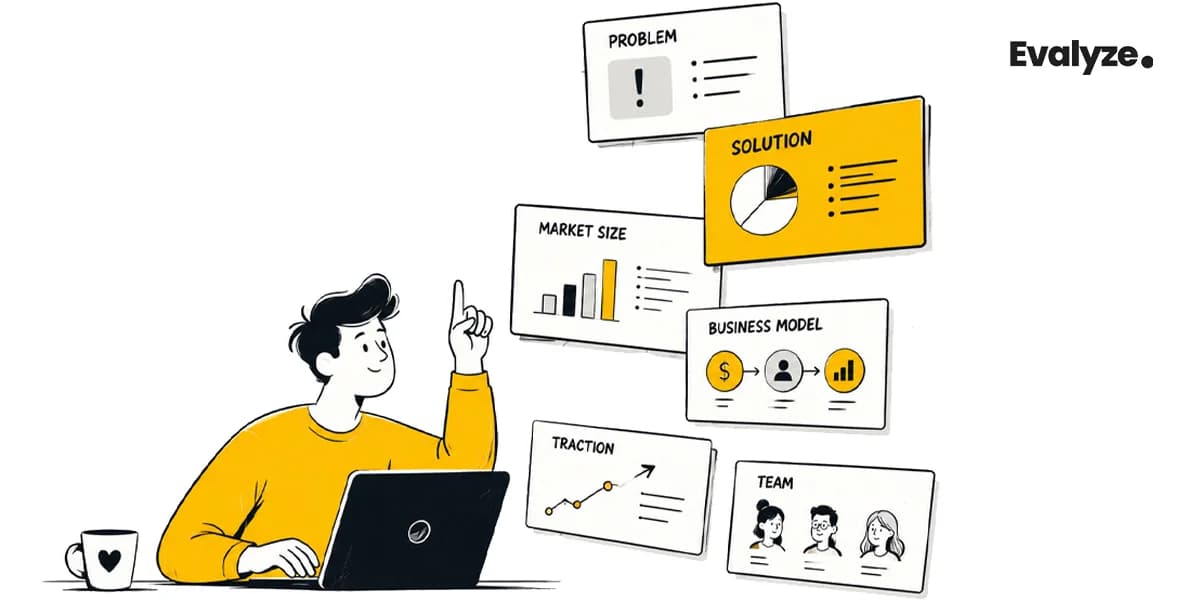
AI can help you draft, rewrite, and challenge a pitch deck. It should not be the source of your facts.
The best AI pitch deck prompts give the model enough context to understand your startup, stage, customers, traction, and fundraising plan. They also tell it what not to invent.
The 20 prompts below cover the main sections of a startup pitch deck. Replace the brackets with your real information, paste the prompt into your preferred AI tool, and edit the result until it sounds like you.
Key takeaways
Spend a few minutes collecting the information AI will need before you start prompting.
Give it:
Then add one instruction to every important prompt:
Use only the information I provide. Do not invent customers, metrics, market data, competitors, financial figures, partnerships, or other evidence. Flag missing information instead.
That one sentence can prevent a polished-looking slide from containing claims you cannot defend in an investor meeting.
Use this when you already have most of the information and want AI to help organize the full story.
Prompt
Act as an early-stage investor reviewing my startup pitch deck.
My startup is [company name]. We are at [pre-seed/seed/Series A] and building [product/service] for [target customer].
We are raising [$X] to achieve [specific milestone].
Use the information below to propose a clear pitch deck structure:
For each slide:
Do not create market figures, traction, customer names, financial assumptions, partnerships, or other facts that I have not supplied.
Use the more specific prompts below when one part of the deck still feels weak.
Giving AI more instructions does not mean giving it more filler. It means telling it what evidence matters and what limits it must respect.
| Weak prompt | Better prompt |
|---|---|
| Write my market slide. | Build a market slide for my pre-seed B2B SaaS startup. Use only the market evidence below. Separate the wider opportunity from the first segment we can realistically reach. Flag missing data instead of estimating it. |
| Make my traction look impressive. | Review these verified traction metrics and identify the strongest evidence of momentum. Suggest one headline and up to three supporting data points. Do not exaggerate the numbers. |
| Write my competition slide. | Compare us with the three alternatives customers currently use. Base the comparison only on the criteria and evidence I provide. Do not claim a competitor lacks a feature unless I have verified it. |
💡 The difference is simple: the better prompt gives AI a job, evidence, and boundaries.
These 20 AI pitch deck prompts are built to help you draft, question, and sharpen each core section of your deck using your real startup information.
Your opening line should tell someone what you do without making them decode industry language first.
Write a one-sentence description of [company name], a [stage] startup building [product/service] for [target customer].
The customer problem is [problem], and our main advantage is [differentiator].
Make the sentence specific enough that an investor unfamiliar with the industry can understand what we do. Avoid hype and vague phrases.
Act as an investor hearing this startup description for the first time:
[paste current elevator pitch]
Tell me:
Then rewrite it in one sentence without adding facts I did not provide.
A problem slide works better when it shows a specific situation rather than a broad industry complaint.
Help me write the problem slide for [company name].
Our target customer is [customer].
Their current problem is [problem].
Today, they deal with it by [current workaround].
The consequence is [cost, delay, lost revenue, risk, frustration, or other verified impact].
Write one headline and up to three short supporting points. Use only the evidence I supplied and flag anything that still sounds too broad.
Explain how [company name] solves [problem] for [target customer].
Our product works by [brief explanation], and the main outcome is [result].
Write:
Keep the focus on the customer result rather than features.
If the deck feels like a collection of separate slides rather than one argument, this guide to building a pitch deck storyline can help connect them.
A huge market number means little if the deck never explains which customers you can realistically reach first.
Help me structure the market slide for [company name].
We sell [product] to [target customer] at approximately [price or contract value].
Our first reachable customer segment contains [verified number of potential customers].
The broader market evidence I have is:
[paste verified market data and sources]
Separate:
Do not estimate missing market figures.
Help me explain why [company name] makes sense now.
Relevant changes include [technology change], [customer behavior], [regulation], [cost change], or [other verified shift].
Identify the strongest one or two changes and explain how they create an opportunity for our startup.
Do not add trends or claims that I have not supplied.
The business model slide should be easy to understand in a few seconds.
Write a simple business model slide for [company name].
We sell [product/service] to [customer].
Customers pay through [subscription/transaction fee/licensing/usage-based/other].
Current or planned pricing is [pricing].
Explain:
Keep the answer short and do not invent unit economics.
Review this pricing model as an early-stage investor:
[paste pricing model]
Our customer is [customer], and the main value we provide is [outcome].
Identify the three questions an investor would probably ask about our pricing.
Then suggest how the slide could explain the pricing more clearly without changing or inventing any numbers.
Revenue is one form of traction. Early-stage founders may also have pilots, active users, retention, signed agreements, waitlists, product usage, or other evidence of demand.
The important part is showing what has actually happened.
Act as a [pre-seed/seed] investor reviewing our traction.
Our verified metrics are:
[paste metrics]
Rank the three strongest signals based on how well they demonstrate demand, growth, retention, or customer commitment.
Suggest:
Do not create benchmarks or change the numbers.
Review this traction slide:
[paste slide content]
Tell me what an investor can confidently conclude from it and what remains unproven.
Rewrite the slide using only the existing evidence. Keep it concise and avoid words such as “strong,” “rapid,” or “significant” unless the numbers clearly support them.
Already have a working deck?
Use these prompts to improve the individual slides, then review the complete story before sending it out.
Analyze My Pitch Deck →
A product slide does not need to explain every feature. It needs to help the investor understand what the product does and why customers care.
Explain [product] for an investor who does not have a technical background.
The product helps [target customer] do [job/outcome].
Its three most relevant capabilities are [feature 1], [feature 2], and [feature 3].
Rewrite these as customer outcomes rather than a feature list.
Keep the result to one headline and three short bullets.
Review this statement about our competitive advantage:
[paste claim]
The evidence behind it is [data, distribution, integration, IP, customer workflow, partnership, switching cost, expertise, or other evidence].
Tell me whether the claim explains something genuinely difficult to copy or simply describes a product feature.
Rewrite it using only the evidence I supplied.
Listing six marketing channels does not make a go-to-market plan stronger. Early-stage investors need to see which channels you are testing first and why they match the customer.
Help me structure the go-to-market slide for [company name].
Our target customer is [customer].
Our average expected deal size is [amount, if known].
We are currently testing or considering:
[channels]
Based only on the context I supplied, choose the three channels that deserve the most attention.
For each one, explain:
Build a simple 90-day go-to-market plan for [company name].
Our goal is [specific goal].
Our team and budget are [resources].
Our target customer is [customer].
Divide the plan into three 30-day phases. For each phase, give us one main objective, the activity required, and the evidence we should collect.
Do not assume resources or channels that I have not mentioned.
Saying you have “no competitors” usually weakens the slide. Customers are solving the problem somehow, even if the alternative is spreadsheets, manual work, agencies, or doing nothing.
Help me structure a competition slide for [company name].
Customers currently choose between:
Compare us using only these verified criteria:
[criteria]
Suggest a clear comparison format and identify where our differentiation is supported by evidence.
Do not claim competitors lack capabilities unless I have provided proof.
Our current differentiation statement is:
[paste statement]
Our actual evidence is:
[paste evidence]
Rewrite the statement so it explains why a customer would choose us over the current alternatives.
Avoid words such as “unique,” “better,” “leading,” or “best” unless the supplied evidence proves the claim.
A team slide should do more than list job titles and previous employers. Relevant experience matters most when the reader can connect it directly to what the company needs to build, sell, or understand.
Write a short pitch deck bio for [founder name].
Their relevant background is:
[experience]
Their connection to this problem is:
[founder-market fit / domain experience / personal experience]
Their most relevant achievement is:
[achievement]
Write two sentences that explain why this experience matters to the startup. Do not turn it into a general professional bio.
Review our team slide as an investor:
[paste team information]
Our company needs to succeed in [product/technical/sales/regulatory/industry areas].
Tell me:
Do not invent experience or imply that an advisor is part of the operating team.
The ask should connect the money you raise to the progress investors expect that capital to buy.
Help me write the fundraising ask for [company name].
We are raising [$X].
Our current monthly burn is [$X].
The round should fund [number] months of runway.
We plan to spend the capital on [categories].
The main milestone we expect to reach is [milestone].
Write one headline and up to three supporting points showing the connection between the capital and the milestone.
Do not change the financial figures.
Act as an investor reviewing this fundraising plan:
[paste use of funds]
Our current stage is [stage], and our next major milestone is [milestone].
Identify:
Do not create new forecasts or recommend changing the raise amount without explaining what evidence would be needed.
If you want to compare your structure with other decks, you can also review these winning startup pitch deck examples.
AI is useful at organizing information and challenging your wording. Problems start when you ask it to make incomplete evidence sound complete.
Watch for these patterns.
If you have not supplied the source, do not assume a market figure in an AI-generated slide is correct.
Ask the model to mark the gap instead:
“Market size requires a verified source.”
Then research it separately.
“Proprietary technology,” “AI-powered platform,” and “better user experience” say little without evidence explaining why another company cannot easily offer the same thing.
Make the model work with your actual advantage.
Founders know their product deeply, so it is easy to give AI ten features and receive ten polished bullets back.
Cut them.
Show what the product enables the customer to do.
Previous companies and degrees can support credibility, but the slide still needs to answer why this team fits this specific problem.
AI can calculate the numbers you provide. It cannot independently know your future growth, conversion rate, hiring needs, churn, or pricing.
If the assumption came from the model instead of your operating plan, do not put it in the deck.
Before you move any AI-generated text into the final deck, check five things:
AI can help you improve individual slides. The final review needs to look across the entire deck.
Upload your finished draft and check which parts need work before you start investor outreach.
FAQ
Five targeted ChatGPT prompts to streamline your startup’s fundraising by crafting compelling pitch decks, emails, and investor messaging.
July 23, 2025

Stop wasting time on generic outreach. Master signal-based cold email templates for investors and new deliverability rules to land more meetings and replies.
May 20, 2026